Betting Limits: Where the Gap Is Largest
Regulated retail sportsbooks in most jurisdictions operate with tight maximum stakes on most markets. NFL spread limits at mainstream US apps commonly run $1,000-$2,000 for regular accounts, with limits applied quickly when an account shows consistent positive yield. Promotional limits on enhanced odds or early prices are usually a fraction of that.
Offshore books with a market-making model accept meaningfully higher stakes because the business model supports it. A book that uses sharp action to move lines can take $10,000 or more per game from informed bettors without treating it as a threat. For bettors whose unit sizes make regulated limits unworkable, this difference is fundamental rather than marginal.
It is worth being precise about what "high limits" actually means at different books. A book advertising high limits but restricting winners after two weeks of positive results is functionally identical to a low-limit book. The real question is whether a book tolerates sustained winning action, not whether it posts impressive nominal maximums.
Odds Quality and Juice
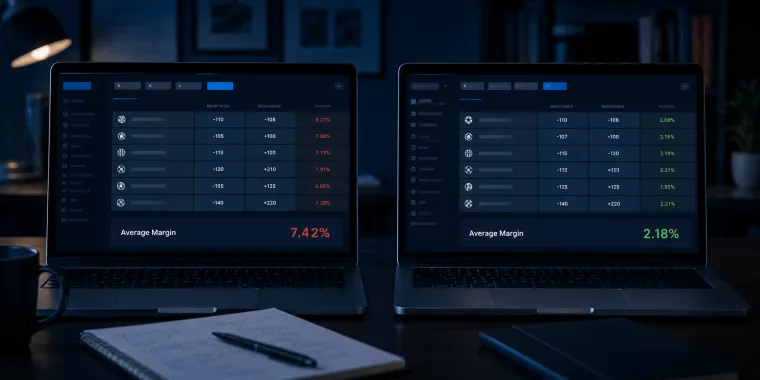
The standard US regulated book prices NFL sides at -110/-110, giving the book a vig of around 4.5%. The best offshore books price the same market at -105/-105, cutting the margin to roughly 2.4%. On a flat-bet strategy, that 2.1% difference compounds significantly over hundreds of bets per year. It is the difference between a marginally profitable strategy and a clearly profitable one at similar edge.
Local regulated books also tend to have slower lines, particularly on prop markets and international sports. They price these markets conservatively and widen the spread to compensate for weaker modeling. Offshore books that take sharp action from professional bettors end up with tighter, more accurate lines on most markets within minutes of posting. For bettors shopping lines, having access to both ecosystems is genuinely valuable.
On in-play markets, the gap is even more pronounced. Many local apps suspend in-play pricing during key moments or offer limited liquidity at wide spreads. Offshore books built for live betting maintain tighter lines and higher limits during the game.
Verification, KYC, and Account Friction
Regulated sportsbooks are required to verify identity before allowing any withdrawal, and many require verification before the first deposit. This means submitting government ID, proof of address, and sometimes source-of-funds documentation. For bettors with large balances, the withdrawal process can involve multiple rounds of documentation.
Offshore books vary considerably in their KYC requirements. Most require some form of identity verification at higher withdrawal thresholds, but the process is typically lighter and faster than regulated equivalents. Crypto-based books often require no ID verification for smaller transactions, which is a genuine operational convenience if you are moving funds regularly.
The trade-off here is legal recourse. A regulated sportsbook has a licensing authority that can mediate disputes. An offshore book does not, in most cases. This is a real asymmetry and worth factoring into how much of your bankroll you keep on any single platform at one time.
Payout Speed and Payment Methods
Bank transfers from regulated books typically take 3-7 business days. Some offer faster e-wallet options, but most bank-originated withdrawals involve manual review before release. During tax season or end-of-year periods, processing times often extend further.
Offshore sportsbooks using crypto can process withdrawals in under an hour for verified accounts. Even those using e-wallets or wire transfers often operate faster than their regulated counterparts. For active bettors managing a rolling bankroll across books, payout speed has practical value beyond convenience.
Choosing Based on Your Betting Profile
For recreational bettors placing a few wagers per week at small stakes, regulated local books offer sufficient functionality with legal clarity. The UX is polished, the limits are adequate for casual play, and recourse options exist if something goes wrong.
For bettors who shop lines, bet multiple markets per week, use any form of systematic edge, or have experienced restrictions at retail books, offshore options provide meaningfully better conditions. The practical question is not which type of book is theoretically superior but which one gives your betting strategy the room to operate.
Most experienced bettors use both: regulated accounts for markets where local books offer competitive lines or bonuses, and offshore accounts for higher volume, higher stakes, or markets where offshore pricing is consistently sharper.